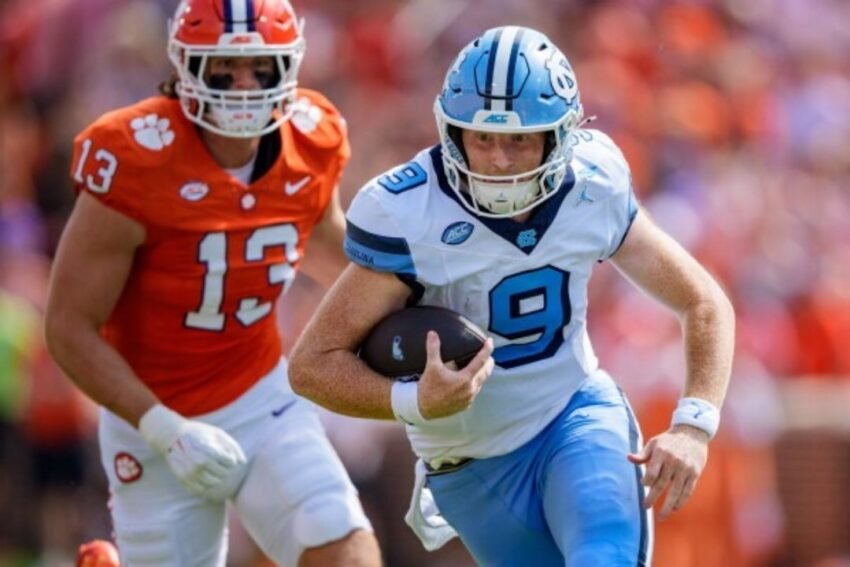
North Carolina and Clemson delivered a dramatic start to the 2026 ACC football season on Saturday, September 19, with the Tar Heels holding a 17-15 lead over the Tigers when lightning forced a weather delay late in the fourth quarter.
The ACC opener at Clemson’s Memorial Stadium had already become a competitive game before severe weather interrupted the action. North Carolina built a 17-3 advantage, but Clemson fought back with 12 unanswered points to make it a two-point contest. When play was stopped, North Carolina had the ball at the Clemson 7-yard line with just over eight minutes remaining.
The game was suspended because lightning was detected within the required safety distance of the stadium. The delay added another unusual chapter to what was already an important early-season matchup for both programs.
North Carolina Takes Early Control
North Carolina entered the game with a 2-0 record and was looking to open its ACC schedule with a road victory. The Tar Heels immediately showed confidence on offense and scored touchdowns on their first two scoring drives.
Running back Demon June opened the scoring with a 3-yard touchdown run. Later, quarterback Billy Edwards Jr. connected with running back Benjamin Hall on a 15-yard touchdown pass, giving North Carolina a 14-3 advantage.
The Tar Heels’ offense moved the ball effectively during the opening half. North Carolina produced 195 yards of total offense before halftime and averaged 5.9 yards per rushing attempt during that period.
Clemson managed to add a field goal before halftime, but North Carolina entered the break with a 17-3 lead.
That early advantage was especially notable because the Tar Heels had struggled against Clemson in recent meetings. WRAL reported that North Carolina had lost seven consecutive games to Clemson entering Saturday’s contest and had not won at Clemson since 2001.
Benjamin Hall Makes an Impact
One of the biggest contributors for North Carolina was Benjamin Hall.
Hall entered the fourth quarter with 126 rushing yards and also contributed a touchdown reception. His ability to produce both as a runner and receiver gave North Carolina another dimension on offense.
Quarterback Billy Edwards Jr. also played an important role. He had thrown for 105 yards and one touchdown when the game was delayed.
The combination of Edwards’ passing and Hall’s rushing production helped the Tar Heels establish their early lead.
North Carolina’s offense was also operating under new leadership this season, with Bobby Petrino serving as offensive coordinator. The early performance against Clemson showed a more productive unit than the one North Carolina fielded during the previous season.
Clemson Starts Its Comeback
Although North Carolina controlled much of the first half, Clemson did not go away.
The Tigers began cutting into the deficit during the second half. Kicker Nolan Hauser added another field goal, and Clemson’s defense created opportunities for the offense.
Freshman quarterback Tait Reynolds, making his first career start, eventually found Christian Bentancur for a 27-yard touchdown pass.
The touchdown was significant for Reynolds because it was his first career touchdown pass. According to the Associated Press report, Reynolds had gone through his first 24 drives of his career, excluding kneel-downs, without leading a touchdown drive.
Clemson’s comeback made the final quarter much more interesting.
Failed Two-Point Conversion Keeps UNC Ahead
After pulling within striking distance, Clemson had an opportunity to tie the game with a two-point conversion.
Instead, the attempt failed.
A trick-play pass from Bryant Wesco to T.J. Moore did not connect, leaving Clemson two points behind. The Tigers therefore remained within one score but could not level the game at that moment.
That failed conversion became an important moment because Clemson continued to trail 17-15 when the weather delay occurred.
Lightning Stops the Game
With North Carolina driving late in the fourth quarter, weather became the biggest factor.
Lightning was detected within eight miles of Memorial Stadium, prompting officials to stop the game. Fans were instructed to leave the seating areas and move to safer locations, including the concourse or their vehicles.
The stoppage came with North Carolina facing second-and-goal at the Clemson 7-yard line and approximately 8:11 remaining in the fourth quarter.
Interestingly, reports noted that no rain had fallen at Memorial Stadium and the sun was shining at the stadium when play was stopped. The lightning threat, rather than heavy rain, was responsible for the interruption.
The delay was also notable because it marked the third consecutive Clemson game affected by weather. The Tigers had experienced weather delays during their season opener at LSU and their following home game against Georgia Southern.
Tait Reynolds Handles His First Start
Clemson’s quarterback situation added another storyline to the ACC opener.
Freshman Tait Reynolds received the start because Christopher Vizzina was unavailable after suffering an elbow injury in Clemson’s previous game against Georgia Southern. Reuters reported before the matchup that Vizzina was expected to miss one to two weeks.
Reynolds responded with a productive passing performance.
He completed 19 of 28 passes for 201 yards, one touchdown and one interception by the time the game was delayed.
His performance helped Clemson recover from the early 17-3 deficit and gave the Tigers a chance to take control late in the game.
For a young quarterback making his first career start, the situation was demanding. He faced a North Carolina team that had opened the season 2-0 and was playing with an opportunity to make a major statement on the road.
Why the ACC Opener Matters
The matchup was the ACC season opener for both North Carolina and Clemson, making the result especially important in the early conference race.
North Carolina entered the game undefeated at 2-0. Clemson was 1-1 after opening the season with a loss to LSU and then defeating Georgia Southern.
The Tigers’ season began with a 51-10 loss to then-No. 11 LSU. Clemson responded the following week with a 22-7 victory over Georgia Southern.
North Carolina, meanwhile, entered Clemson after victories over its first two opponents.
That made Saturday’s matchup an early test for both programs.
A Different Game From Last Season
The 2026 meeting also looked very different from the teams’ previous matchup.
In the 2025 game, Clemson took control almost immediately, leading North Carolina 28-3 after the first quarter and 35-3 at halftime.
This time, North Carolina came out aggressively and controlled the first half.
The Tar Heels’ 17-3 advantage demonstrated how much the matchup had changed from the previous season. Clemson’s second-half response, however, showed that the Tigers still had an opportunity to turn the game around.
Weather Creates an Unusual Finish
Weather delays are not unusual in college football, especially when lightning is nearby. However, the timing of this particular delay made it especially dramatic.
Instead of stopping before halftime or during a normal change of possession, officials halted the game while North Carolina was threatening to score.
The Tar Heels had possession near the goal line and were in position to potentially extend their lead.
Clemson’s defense therefore faced a critical situation when play eventually resumes.
For North Carolina, the challenge is to maintain momentum after a long interruption. For Clemson, the break provides additional time to regroup and prepare for the decisive final minutes.
What Happens Next?
When play resumes, North Carolina will have a major opportunity to increase its advantage.
The Tar Heels are positioned at the Clemson 7-yard line on second down. A touchdown would significantly change the situation, while a Clemson defensive stop could keep the Tigers within striking distance.
Clemson would then need to produce another scoring drive to complete the comeback.
At the time of the stoppage, North Carolina led 17-15 with 8:11 remaining.
The final result therefore remained undecided at the time of the latest reports.
North Carolina’s Upcoming Schedule
After the Clemson matchup, North Carolina is scheduled for a bye week.
The Tar Heels are then set to return to action on October 3 against No. 3 Notre Dame.
That game will provide another major test for North Carolina as the team continues its 2026 schedule.
The Tar Heels’ performance against Clemson could also provide useful momentum heading into that matchup, depending on how the weather-delayed game ultimately concludes.
Clemson’s Next Game
Clemson is scheduled to travel west to face California on Friday, September 25.
The Tigers will have to manage a short turnaround following the unusual ACC opener and weather interruption.
The California game will provide Clemson with another opportunity to evaluate its offense and its young quarterback situation.
Final Thoughts
The North Carolina-Clemson ACC opener became one of the more unusual games of the early 2026 college football season.
North Carolina started strongly, taking a 17-3 lead and controlling the first half. Benjamin Hall produced a major performance on the ground, while Billy Edwards Jr. provided a touchdown through the air.
Clemson responded after halftime. Tait Reynolds showed progress in his first career start, throwing his first touchdown pass to Christian Bentancur. Nolan Hauser also contributed three field goals as Clemson gradually reduced the deficit.
The Tigers came within two points, but their failed two-point conversion prevented them from tying the game.
Then, with North Carolina threatening to score again, lightning forced the game into a delay.
At the stoppage, North Carolina led Clemson 17-15 with 8:11 remaining in the fourth quarter, and the Tar Heels faced second-and-goal at the Clemson 7-yard line.
The weather interruption left both teams waiting for the final chapter of an important ACC opener.